Museum Island’s five museums were built between 1830 and 1930, reflecting over a century of evolving architectural styles and museum concepts. The vision was to create a unified space for world-class cultural and historical exhibitions.
During World War II, Museum Island suffered significant destruction, with some artifacts lost forever. The Neues Museum, in particular, remained in ruins for decades before its restoration was completed in 2009.
The Bust of Nefertiti, one of the most famous artifacts in Museum Island’s collection, was hidden away during World War II to prevent destruction. It was rediscovered after the war and eventually displayed in the Neues Museum, where it remains today.
Must-see attractions and collections
1/3
Sculpture and painting (13th to 18th century)
The Bode Museum’s sculpture collection spans the Gothic to Baroqueperiods, showcasing masterpieces by Donatello, Riemenschneider, and Bernini. Browse an extensive display of Italian Renaissance sculptures, including works by Luca della Robbia and Andrea della Verrocchio, alongside religious panels. Together, they offer a deep dive into the dynamic interplay of artistic styles and cultural influences.
Coins and medals
Home to the Münzkabinett, one of the world’s largest numismatic collections, the museum showcases over 500,000 coins and medals from ancient Greece and Rome to modern Europe. See the gold aurei of Roman emperors, the silver drachmas of ancient Greece, and the intricate talers of the Holy Roman Empire—each telling a story of power, trade, and artistry.
Late antique and Byzantine art
Step into the world of early Christian and Byzantine art at the Bode Museum, featuring fragments of basilicas, ivory panels, vibrant mosaics, and sacred artifacts from the 3rd to the 15th century. Get up close to stunning Byzantine icons that once played a central role in religious rituals, and examine ancient coins that reveal the empire’s economic and political power.
Iconic artifacts you can’t miss at the Bode Museum
Christ the Merciful mosaic
Origin: Constantinople, first quarter of the 12th century
A masterpiece of Byzantine mosaic art, this depiction of Christ reflects the empire’s theological vision through its intricate gold background and delicate detailing.
What’s on | Current exhibitions at the Bode Museum
Leaps in Time: Art sees Art
From: February 2025 to April 2025
Young artists from the Hochschule für Bildende Künste Saar (HBKsaar) reinterpret classical artworks through installations, photo art, augmented reality, and videos, creating a dynamic dialogue between past and present.
Dress to Impress: Reconstructions of Medieval Robes from Nubia
From: February 2025 to April 2025
This exhibition presents meticulously reconstructed garments from wall paintings in the Cathedral of Faras, offering a glimpse into the rich attire of medieval Nubian royalty and clergy, influenced by Byzantine, African, and Arabic traditions.
Sticky Fingers: Counterfeit Coins: The Dark Side of Numismatics
From: May 2024 to September 2025
This exhibition delves into the world of coin forgery, comparing original and counterfeit coins, and showcasing the techniques used by counterfeiters. It also offers visitors a hands-on opportunity to test methods of detecting counterfeits.
The Baptismal Font from Siena: History, Restoration, and Reinstallation of a Plaster Cast Model
From: October 2024 until further notice
The Baptismal Font from Siena stands as a testament to Italian Renaissance craftsmanship. This exhibition uncovers its journey—from its original creation to its plaster cast reproduction, restoration, and enduring influence on religious art.
What’s next | Bode Museum’s upcoming exhibitions
The Angel of History: Walter Benjamin, Paul Klee, & the Berlin Angels 80 Years after WWII
From: May 2025 to July 2025
Centered around Paul Klee's Angelus Novus (1920), once owned by philosopher Walter Benjamin, this exhibition explores themes of history and memory, featuring damaged angelic artworks from Berlin museums and excerpts from Wim Wenders' film Wings of Desire.
The Pazzi Conspiracy: Power, Violence, & Art in Renaissance-Era Florence
From: October 2025 to September 2026
This exhibition delves into the 1478 assassination attempt on the Medici brothers, showcasing medals and portraits from the Münzkabinett and Gemäldegalerie that depict key figures, illustrating how political intrigue inspired Renaissance art.
A glimpse into the museum archive
Golden Passion: George Petel & the Mystery of his Crucifixion Group
From: July 2024 to October 2024
This exhibition showcased the once-separated components of Petel's gilded Crucifixion group, reuniting the figure of Christ from the Bayerisches National Museum in Munich with two accompanying figures from the Bode Museum.
Berliner Salon: Fashion Week in Bode Museum
From: July 2024
As part of Berlin Fashion Week, the Berliner Salon brought together young designers in the historic halls of the Bode Museum, juxtaposing contemporary fashion with classical art and exploring the connection between modern design and art history.
Theodoulos Polyviou: SCREEN: A Contemporary Art Intervention
From: November 2023 to March 2024
Cypriot artist Theodoulos Polyviou presented a multimedia installation within the museum’s classical architecture, challenging perceptions of space and reality through contemporary art.
Spanish Dialogues: Picasso's works from the Museum Berggruen
From: July 2023 to April 2024
This exhibition showcased a selection of Picasso’s works from the Museum Berggruen, examining his dialogue with Spanish artistic traditions and his lasting impact on modern art.
The Bode Museum’s storied past
Late 19th century: Emperor Wilhelm II commissions the museum’s construction, and architect Ernst von Ihne designs its layout.
1897: Construction of the museum officially begins.
October 18, 1904: The museum opens to the public, under the name Kaiser-Friedrich-Museum, in honor of Wilhelm II’s father, Emperor Frederick III.
1939 to 1945 (World War II): The museum suffers severe bomb damage, and many artworks are evacuated for protection.
1956: It is renamed the Bode Museum to honor Wilhelm von Bode, an art historian who champions the idea of displaying sculptures, paintings, and decorative arts together, an innovative approach that continues to define the museum’s curation today.
Post-war period: Reconstruction takes place in phases, gradually restoring the building and collections.
1997 to 2006: A major renovation modernizes the museum while preserving its historic architecture, allowing the museum to reopen with state-of-the-art facilities and enhanced exhibition spaces.
Today: The Bode Museum is home to one of the world’s most significant sculpture collections, housing masterpieces from the Italian Renaissance, German Gothic, and Baroque periods.
Architectural brilliance
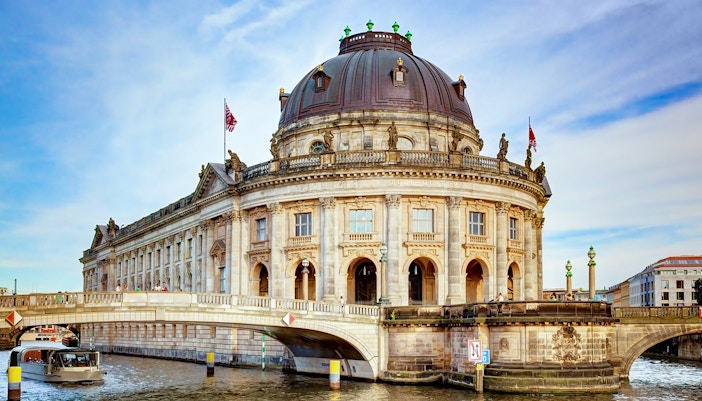
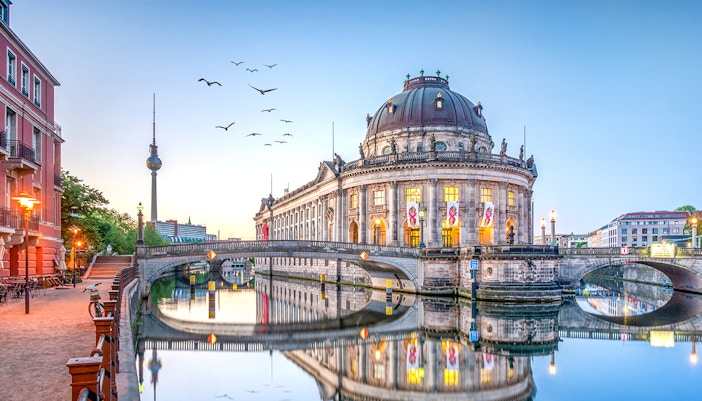
The Bode Museum is a stunning example of Neo-Baroque architecture, designed by Ernst von Ihne and completed in 1904. Perched at the northern tip of Museum Island, its majestic dome and symmetrical facade are an iconic part of the city’s skyline. Unlike traditional museums with linear galleries, the museum’s fluid, interconnected spaces display sculptures, paintings, and decorative arts together. Its grand staircase, intricate moldings, and arched windows add to the elegance, while the central dome bathes the interior in natural light. With stone, marble, and gilded details mirroring the richness of its collections, the building itself becomes part of the museum experience.
Interesting facts about the Bode Museum
1/3
Multaka: Museum as ‘meeting point’
Since 2015, the Bode Museum has participated in the ‘Multaka’ project (which means “meeting point” in Arabic). This initiative offers guided tours led by refugees in Arabic and Persian, fostering cultural exchange and providing unique perspectives on the museum's collections.
The lost Equestrian statue
Around 1904, the Bode Museum’s forecourt showcased a grand equestrian statue of Emperor Frederick III, sculpted by Rudolf Maison. During the East German era, the statue was removed and destroyed, leaving behind only historical photographs as a reminder of its lost presence.
The ‘Flora Bust’ controversy
In 1909, Wilhelm von Bode acquired a wax bust named Flora, believing it to be a work by Leonardo da Vinci. However, in 1910, it was revealed that the bust may have been created by English sculptor Richard Cockle Lucas. Despite evidence suggesting its 19th-century origin, Bode maintained his attribution to da Vinci. In 2021, carbon-14 dating confirmed the bust was sculpted in the 19th century. Today, it remains on display, labeled ‘England, 19th Century’, with a question mark, highlighting the complexities of art authentication.
Frequently asked questions about the Bode Museum
The Bode Museum houses over 500,000 coins and medals in the Coin Cabinet and an extensive collection of sculptures, Byzantine art, and paintings spanning from late antiquity to the 18th century.
Some of the Bode Museum's most renowned exhibits include Donatello’s Pazzi Madonna, Tilman Riemenschneider’s Luke the Evangelist, Antonio Canova’s Dancer, and the Christ the Merciful mosaic from 12th-century Constantinople—each showcasing the evolution of sculpture and religious artistry across different eras.
No, the 2017 theft of the 100-kilogram ‘Big Maple Leaf’ gold coin has not been fully resolved, although some suspects were arrested, and part of the stolen gold is believed to have been melted down.
Yes, the Bode Museum occasionally hosts opera performances, concerts, and cultural events, with its grand halls and domed ceilings creating a stunning backdrop.
The Bode Museum is least crowded on weekday mornings, especially right after it opens at 10am and around lunchtime.
Yes! Your skip-the-line ticket gives you fast-track entry to the Bode Museum, including to all special exhibitions. Plus, you can learn more about the artifacts with the included audio guide, available in English and German.
A 2 to 3-hour visit is ideal to explore the major collections, but art enthusiasts may want to spend half a day or more to fully appreciate the details.
Yes, photography is allowed for personal use, but flash and tripods are prohibited. Some special exhibitions may have restrictions.
Absolutely! With its world-class sculpture collection, Byzantine treasures, and vast numismatic exhibits, the Bode Museum offers a unique and enriching experience for art and history lovers.