Visiting Fotografiska Berlin: your planning guide
Fotografiska Berlin is a contemporary photography museum in Mitte, best known for its rotating exhibitions, late hours, and day-to-night social atmosphere inside the restored Tacheles building. It is not a huge museum, but the five-floor layout is nonlinear enough that casual wandering can mean missing whole rooms. The biggest difference between an average visit and a good one is checking what is on before you arrive and pacing your route by floor. This guide covers timing, entry, layout, and what to prioritize.
Quick overview: Fotografiska Berlin at a glance
If you want the short version before you book, here’s what will actually shape your visit.
- When to visit: Daily, 10am–11pm. Weekday mornings from 10am–12 noon are noticeably calmer than Friday and Saturday evenings, because locals often come later for the bar, dinner, and events as much as the exhibitions.
- Getting in: From €15 for standard entry. Guided tours start from €19 including admission. You can usually book close to your visit date, but weekend evenings and major exhibition openings are the times to lock in sooner.
- How long to allow: 1–2 hours for most visitors. It stretches closer to 2.5 hours if you read curatorial texts, linger in immersive rooms, and finish with Clara rooftop bar or the bakery.
- What most people miss: The preserved graffiti stairwells and architectural details of Tacheles are easy to rush past, and the nonlinear layout means some visitors skip an entire room without realizing it.
- Is a guide worth it? Yes, if you want context for the current exhibitions and building history; if you mainly want to browse at your own pace, standard entry does the job well for less.
Jump to what you need
🕒 Where and when to go
🎟️ Which ticket is right for you?
🗺️ Getting around
🖼️ What to see
♿ Facilities and accessibility
Where and when to go
How do you get to Fotografiska Berlin?
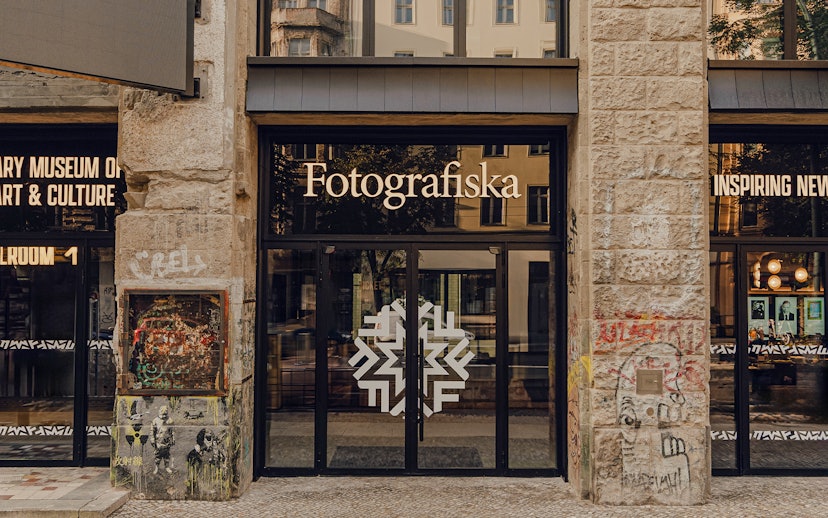
Fotografiska Berlin sits on Oranienburger Straße in Mitte, around the Friedrichstraße and Hackescher Markt area, and is an easy walk from several central transit stops.
Oranienburger Straße 54, 10117 Berlin, Germany
- S-Bahn: Oranienburger Straße station → 3-min walk → Best direct option from Berlin Hbf and Brandenburg Gate.
- U-Bahn: Oranienburger Tor (U6) → 2-min walk → Easiest if you’re coming from Stadtmitte or Friedrichstraße.
- Tram: M1, M5, or 12 to Oranienburger Tor / S Oranienburger Straße → 1–3 min walk → Useful from Alexanderplatz.
- Taxi / rideshare: Drop-off at Oranienburger Straße 54 → near-direct access to the Tacheles entrance.
Which entrance should you use?
Fotografiska Berlin uses a single public entrance in the Tacheles complex, so the main thing people get wrong is assuming there are separate access points for exhibitions, restaurant, or rooftop visitors.
- Located at: The main entrance on Oranienburger Straße 54. Expect 5–15 min wait during Saturday evenings or just after a major exhibition opening.
When is Fotografiska Berlin open?
- Monday–Sunday: 10am–11pm
- Last entry: 10pm
When is it busiest? Friday and Saturday from 6pm–9pm, plus rainy weekend afternoons, when the museum fills with both exhibition visitors and people heading for drinks or dinner in the building.
When should you actually go? Weekdays from 10am–12 noon are your easiest window for quiet galleries, cleaner sightlines, and unhurried time in the stairwells and larger installation rooms.
Which Fotografiska Berlin ticket is best for you
| Ticket type | What's included | Best for | Price range |
|---|---|---|---|
Fotografiska Berlin Tickets | Entry to Fotografiska Berlin + admission to all exhibition spaces | A flexible visit where you want mobile entry sorted in advance and no need to stop at the ticket desk first | From €15 |
On-site general admission | Same-day entry to all exhibition spaces | A spontaneous weekday visit when you’re happy to buy at the museum and availability is still wide open | From €15 |
Admission + official guided tour | Entry + 60-min guided tour | A first visit where you want curatorial context and building history without piecing the route together yourself | From €19 |
Private group tour | Admission + private guided visit | A school, club, or group booking that needs a fixed start time and a more structured experience | From €20 per person |
How do you get around Fotografiska Berlin?
Fotografiska Berlin is a multi-floor museum with a slightly nonlinear layout, so it’s easy to self-navigate once you know where the current exhibitions are, but just wandering can mean missing an entire room.
- Ground floor: Tickets, entry, bakery-café, and concept store → 15–20 min if you want coffee or a bookstore stop before leaving.
- Main gallery floors: The rotating exhibitions sit across several levels → budget 20–30 min per floor if you read captions and linger with the stronger work.
- Immersive rooms: Multimedia or installation-heavy spaces vary by exhibition → allow 10–15 min each because these are the easiest rooms to rush through too quickly.
- Rooftop level: Clara bar and city views → 20–40 min if you’re ending your visit with a drink.
Suggested route: Start with the highest exhibition floor in use and work downward, then finish with the shop, bakery, or Clara; this works best because the circulation is not fully linear, and most backtracking happens when people leave the upper levels for later.
Maps and navigation tools
- Map: Current exhibitions rotate across multiple levels, so check the day’s floor layout at the entrance before you head upstairs.
- Signage: Signage is serviceable, but it is not strong enough to guarantee you won’t miss a room if you move too quickly between floors.
- Audio guide / app: Not applicable.
💡 Pro tip: Start at the top and work down — the layout feels much clearer that way, and you’re less likely to miss a gallery tucked off the stairwell circulation.
Get the Fotografiska Berlin map / audio guide
Where are the masterpieces inside Fotografiska Berlin?

Headline temporary exhibitions
Artist: Contemporary photography by international and emerging artists
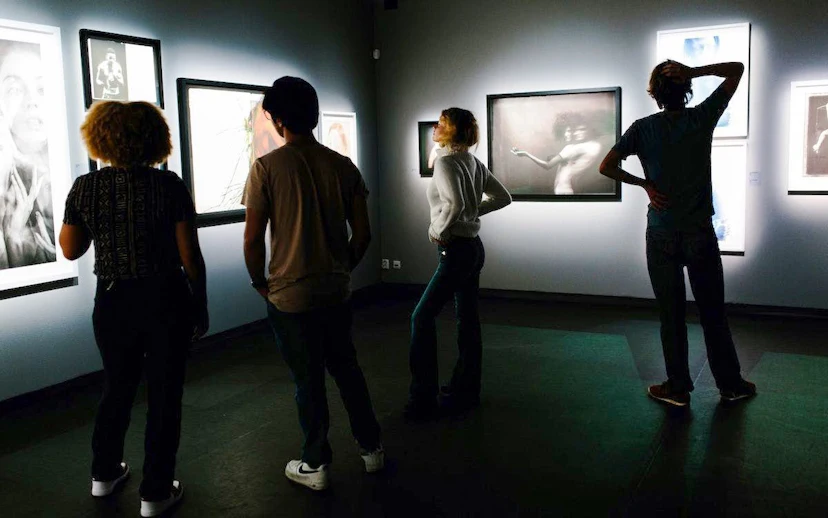
The main reason to come is the current exhibition lineup, which changes often enough that repeat visits feel worthwhile. Expect a mix of documentary work, conceptual photography, installation, and image-led storytelling rather than a classic greatest-hits museum hang. What many visitors miss is how much meaning sits in the curatorial text and sequencing between rooms, not just in the individual images.
Where to find it: Across the main exhibition floors above the entry level; check the current floor layout as soon as you arrive.
Tacheles stairwells and preserved graffiti
Architecture: Historic building detail from the former Kunsthaus Tacheles
The stairwells are part of the experience, not just the way between floors. Preserved graffiti and rougher architectural details give you a direct sense of the building’s art-squat history, which makes the polished gallery spaces feel more Berlin and less generic. Most visitors move through too fast and don’t stop to look up, back, and across the landings.
Where to find it: In the main circulation stairwells connecting the gallery floors inside the Tacheles building.
Immersive installation rooms
Art: Exhibition-specific multimedia and installation spaces
Some of the strongest rooms here are the ones that move beyond framed prints into sound, scale, projection, or immersive display. They break up the pace of the visit and help contextualize the current social or political themes in the program. The detail people often miss is that these rooms reward a full loop, because the strongest sightline is not always the one you get from the doorway.
Where to find it: Within the temporary exhibition route on the upper gallery levels; look for darker rooms and expanded installation spaces.
Clara rooftop bar
Architecture: Rooftop bar and viewing spot
Clara is worth treating as part of the visit, especially if you’re coming later in the day. The city views add a completely different finish after several floors of exhibitions, and the glass-dome setting makes it feel more like a Berlin evening stop than a museum add-on. What people miss is timing: go close to sunset or after dark, not just whenever you remember on the way out.
Where to find it: On the top level of the building above the galleries.
Concept store and photobook selection
Facility: Museum shop and photography book retail
The store is stronger than a standard museum gift shop, especially if you like photobooks, small design objects, and exhibition-related titles. It’s the easiest way to extend a show that really lands for you without committing to a full catalog at gallery prices elsewhere. Most visitors only give it 5 minutes, but 15 minutes is enough to spot the best books.
Where to find it: Near the entrance and exit flow on the ground floor.
Facilities and accessibility
- 🎒 Cloakroom / lockers: Baggage facilities are available, and large bags are better left there before you start because the galleries are spread across several floors.
- 🍽️ Café / restaurant / bars: You’ve got the Verōnika restaurant, a café-bar and bakery, and the Clara rooftop bar, so it’s easy to turn the visit into a meal or evening stop rather than a quick museum loop.
- 🛍️ Gift shop / merchandise: The concept store is on-site and worth a proper browse for photography books, design items, and more thoughtful souvenirs than standard museum merch.
- 🪑 Seating / rest areas: Dining spaces and bar areas give you the easiest built-in breaks, which matters if you’re stretching the visit into a longer afternoon or evening.
- 💳 Cashless payments: The museum is cashless, so bring a card or digital payment method for tickets, drinks, food, and shop purchases.
- 🐾 Pet policy: Leashed dogs are allowed, which is unusually relaxed for a museum and helpful if you’re building this into a longer day in Mitte.
- ♿ Mobility: Plan ahead for step-free access needs, because the current visitor-facing information does not spell out lift routes, accessible restrooms, or wheelchair-loan details floor by floor.
- 👁️ Visual impairments: Current planning information does not list tactile maps, audio description tools, or guide-dog details, so it’s worth confirming support directly before your visit.
- 🧠 Cognitive and sensory needs: Weekday mornings are the easiest low-stimulation window, while Friday and Saturday evenings tend to feel busier, louder, and more social.
- 👨👩👧 Families and strollers: The museum welcomes families, but the multi-floor layout means it helps to confirm stroller logistics in advance if you want the smoothest route through every level.
Fotografiska Berlin works best for older children and teens who already like images, design, or current culture, because the payoff here is looking, discussing, and reacting more than pressing buttons or doing hands-on activities.
- 🕐 Time: Around 45–75 minutes is realistic with children if you focus on the boldest rooms and skip the slower reading-heavy sections.
- 🏠 Facilities: Children up to the age of 12 years enter free with an adult, and the bakery, café, and rest stops make it easier to break the visit into shorter chunks.
- 💡 Engagement: Let children choose one photograph per room and say why it stands out, because the exhibitions are stronger when you treat them as conversation starters.
- 🎒 Logistics: Bring a card, not cash, travel light, and aim for weekday mornings if you want more space to move and fewer distractions.
- 📍 After your visit: A short walk around Hackescher Markt is the easiest family-friendly add-on if everyone still has energy after the museum.
Rules and restrictions
What you need to know before you go
- Entry requirement: A valid admission ticket is required, and reduced-rate visitors should carry the ID that proves their discount category.
- Bag policy: Large bags are best checked in the baggage facility before you start, because moving them through a multi-floor museum slows the visit down fast.
- Re-entry policy: Same-day re-entry is generally possible with proof of ticket or a stamp, which makes it easier to break for food or come back up for the rooftop later.
- Dress guidance: There is no enforced dress code, but layers are a smart call if you’re combining galleries with the rooftop bar.
Not allowed
- 🖐️ Touching exhibits: Keep your hands off prints, frames, and installations, especially in immersive rooms where the boundaries can feel less obvious.
- 🐾 Pets: Leashed dogs are allowed, but they need to stay controlled in tighter gallery areas, elevators, and busier evening crowds.
Photography
Personal photography is generally allowed and common throughout Fotografiska Berlin, which is one reason the museum feels more relaxed than a traditional gallery. The important distinction is method, not mood: stick to non-flash handheld photography in the exhibition spaces, and take extra care in darker immersive rooms where bright light would disrupt the experience. If you’re photographing the stairwells or rooftop, move aside rather than blocking circulation.
Good to know
- Cashless only: The museum does not take cash, so showing up with only cash means queuing twice — once to figure it out, and again after sorting payment.
- Event schedule: Late hours are a real perk, but occasional private events can trigger earlier last entry or floor closures, so check the day’s schedule before you set your timing.
Practical tips
- Booking and arrival: Same-day booking is usually fine here, but Friday and Saturday evenings are the slots to reserve earlier if you want a smoother start and no ticket-desk pause.
- Pacing: Save your concentration for the strongest headline rooms first, because many visitors spend too long on the opening floor and then skim the upper galleries once they realize how much is left.
- Crowd management: Weekday mornings from 10am–12 noon work especially well because you get quieter galleries before the after-work and dinner crowd starts using the building as a social space.
- What to bring or leave behind: Bring a card, not cash, and keep your bag small; using the baggage facility is easy, but starting light makes the multi-floor route much more comfortable.
- Food and drink: If you want a proper meal, book Verōnika ahead for weekend evenings; if you just need a reset, the bakery is the better low-commitment stop before or after the galleries.
- Route planning: Start on the highest exhibition floor in use and work down, because the layout is not perfectly intuitive and that order cuts the odds of missing a room.
- Check the schedule: Always glance at the event calendar before you go, because late-night access is one of this museum’s strengths, but special events can occasionally change the normal rhythm.
- Build in an ending: Don’t treat Clara as an afterthought — adding even 20 minutes there makes the whole visit feel more complete, especially if you arrive in the late afternoon.
What else is worth visiting nearby?
Commonly Paired: New Synagogue
Distance: 200m — 3 min walk
Why people combine them: They sit on the same street, and the pairing gives you a strong contrast between contemporary image culture and the deeper history of the neighborhood.
Commonly Paired: Museum Island
Distance: 1km — 12 min walk
Why people combine them: It makes for a very efficient same-day culture plan — classical museums earlier, then Fotografiska later when its late hours and food options start to matter.
Also nearby
Hackesche Höfe
Distance: 700m — 8 min walk
Worth knowing: It’s the easiest nearby detour if you want courtyards, design shops, and a more relaxed post-museum wander without committing to another big attraction.
Berlin Cathedral
Distance: 1km — 15 min walk
Worth knowing: If you still want one more major landmark after the museum, this is the most recognizable sight within easy walking distance.
Eat, shop and stay near Fotografiska Berlin
- On-site: Verōnika is the full restaurant option, while the café-bar, bakery, and Clara rooftop bar give you easier ways to stretch the visit with coffee, pastries, or drinks; unlike many museum food options, these are part of the appeal here.
- Better options nearby: Not applicable.
- Pro tip: If you want dinner and exhibitions on the same visit, do the galleries first and eat after 7pm — that pacing fits the museum’s late hours better and helps you avoid feeling rushed on the upper floors.
- Concept store: The on-site shop is the one worth prioritizing here, with photobooks, design objects, and Berlin-linked creative merchandise near the exit flow.
- Exhibition books: If a show really lands for you, check the related titles before leaving; this is one of the better places in the building to turn a temporary exhibition into something lasting.
Yes, if you’re on a short trip and want to be able to walk to restaurants, bars, transit, and several cultural stops without much planning. Mitte is convenient and lively, but it is not the cheapest part of Berlin, so it works best for travelers who value location over hotel value. If you want Fotografiska Berlin to be part of an easy evening out, this area makes sense.
- Price point: The area skews mid-range to expensive, especially close to Oranienburger Straße and the core Mitte sights.
- Best for: Short stays, culture-heavy weekends, and travelers who want to walk back from dinner or a late museum visit instead of relying on transit.
- Consider instead: Alexanderplatz works better if you want cheaper transport convenience, while Potsdamer Platz is the easier base if you’re pairing East and West Berlin museums across the same trip.
Frequently asked questions about visiting Fotografiska Berlin
Most visits take 1–2 hours. If you read curatorial texts closely, spend longer in the immersive rooms, and finish with the shop or rooftop bar, it can stretch to around 2.5 hours. The museum is not enormous, but the multi-floor layout rewards a slower pace more than people expect.
No, you usually don’t need to book far in advance. Most visitors decide close to the day because general admission rarely sells out, but weekend evenings and major exhibition openings are the times when booking ahead saves the most hassle.
You only need to arrive around 10–15 minutes early. Fotografiska Berlin is more flexible than a strict timed-entry museum, but that small buffer helps if you need to use the baggage facility, validate a reduced ticket, or get your bearings before heading upstairs.
Yes, but large bags are better checked before you start. The museum has baggage facilities, and using them makes the visit easier because you’ll be moving across several floors, stairwells, and tighter gallery spaces rather than following one simple linear route.
Yes, personal photography is generally allowed. The safest approach is to stick to non-flash handheld shots in the galleries, stairwells, and rooftop areas, because the museum’s relaxed atmosphere does not mean bright flash or bulky setups are welcome in exhibition rooms.
Yes, group visits are straightforward here. The museum offers private group tours for larger parties, and the venue’s mix of exhibitions, food, and late hours works especially well for school groups, creative teams, and club outings that want something more social than a standard museum stop.
Yes, especially with older children and teens. Children up to the age of 12 years enter free with an adult, and the relaxed atmosphere helps, but the content is still exhibition-led rather than hands-on, so younger children usually do better with a shorter 45–75 minute route.
You should confirm the exact access route before you go. The museum sits in a public multi-floor venue, but the published visitor information does not clearly map out lift access, accessible restrooms, or wheelchair-loan details, so it is worth checking directly if step-free access is essential.
Yes, and it’s one of the better reasons to slow down your visit. Inside the building you’ve got Verōnika, a café-bar and bakery, and the Clara rooftop bar, so you can easily add anything from a pastry stop to a full dinner without leaving the venue.
Yes, leashed dogs are allowed. That makes Fotografiska Berlin unusually relaxed for a museum, but it still helps to visit at quieter times if you’re bringing a dog, because evening crowds around the galleries, elevators, restaurant, and rooftop can feel much tighter.
No, it’s a cashless venue. Bring a card or digital payment method for tickets, drinks, food, and shop purchases, because arriving with cash only can slow your visit down before you even get through the entrance.
The exhibitions change regularly, so the answer depends on when you visit. Fotografiska Berlin has no permanent collection, which is part of the appeal, but it also means checking the current lineup before you go makes a real difference to how well the visit matches your interests.